Origins
Dictyoptera (aka, roaches, termites, and mantises) all evolved from an early insect group called roachoids (or Eoblattodea), one of the insect groups that survived the worst mass extinction even we know of, the Permian-Triassic extinction event (aka, The Great dying). Though called an event, the Great Dying was tens of thousands of years of nightmarish conditions caused by overlapping/related disasters.
It was in the middle of this period that harsh conditions shaped the rapid evolution of a branch of very social, intelligent, and dextrous Eoblattodea. These were the first bugfolk.
Appearance & Biology
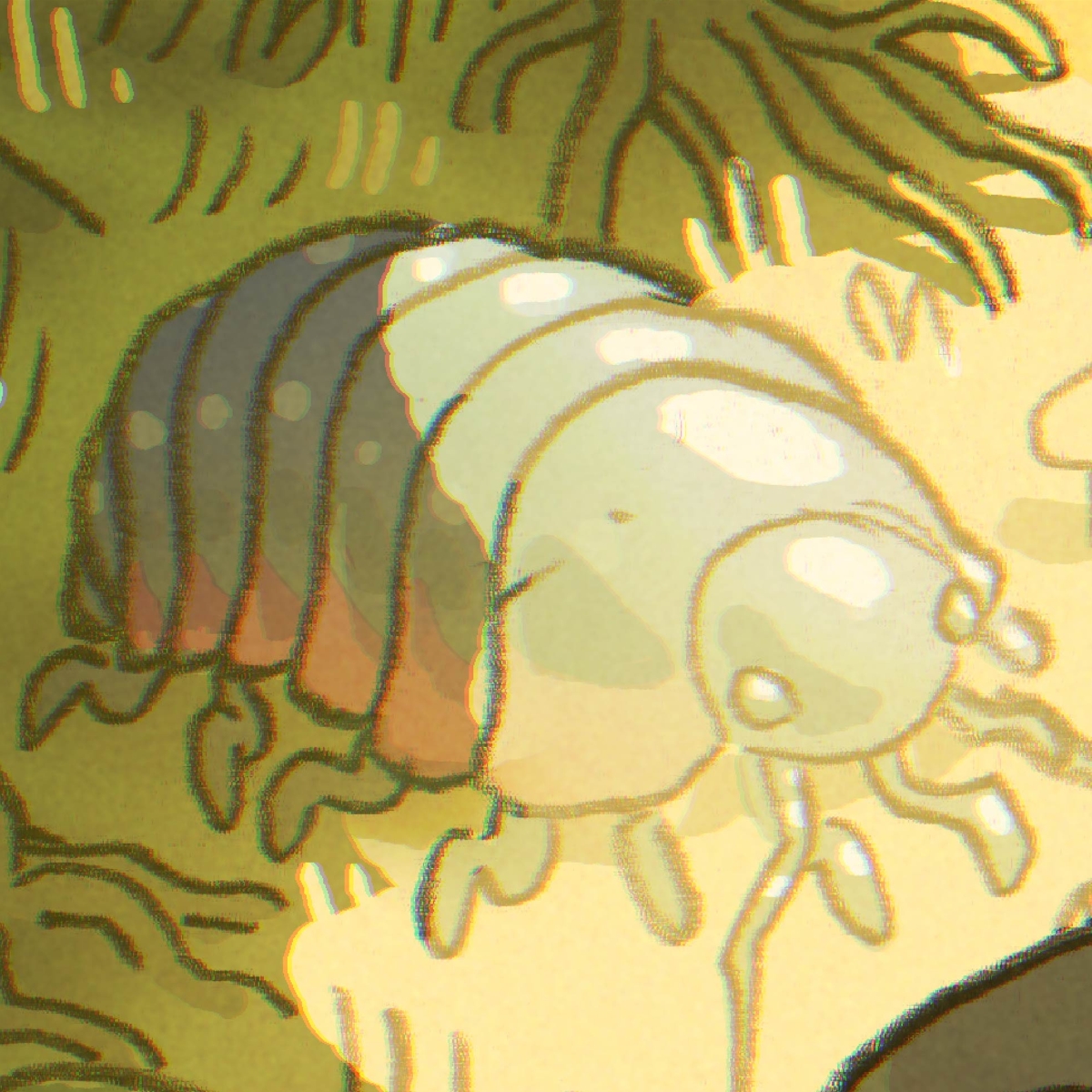
Bugfolk are usually under 2 inches tall, and they most closely resemble mantises or cockroaches. Like roaches, their bodies are compact, and they have powerful legs. Like mantises, they're more slender than most roaches and have tympanal organs (ears) on their thorax. They have a single pair of vestigial wings[1]. Their four arms have three flexible finger-claws.
Unlike most insects, bugfolk continue to molt throughout their lives, allowing them to regenerate missing limbs or damaged shell. A healthy bugfolk that survives to adulthood in an established community is likely to live 10-20 years.
Bugfolk language is a complex mix of gestures, sounds (chirps and hisses made with modified spiracles on their abdoment and clicks made with their mandibles), and pheromone signals. They have a written notation that can convey information with or without chemical annotation.
Culture & lifestyle
Naturally sociable, bugfolk once lived in extensive cities constructed in places safe from large mammals. They devised ways to harness geothermal energy to generate electricity and regulate the ambient temperature of their dwellings. They developed complex cultural traditions, traveling and communicating across great distances.
Humans, with their curiosity, focus, and destructive tendencies, proved too hard to avoid. Bugfolk society declined as communities became smaller and more secretive. Over time, bugfolk society has fragmented into isolated, low-tech communities whose survival depends on remaining hidden. Few folk even know of the scale of their ancestors’ achievements.
One technology they have retained is the ability to synthesize pheromonal compounds to tame or repel other creatures. Chemist-historians called monewitches study an ancient curriculum to learn the chemistry and tools needed to brew these compounds with the tools at their disposal. No community lasts long without a well-trained monewitch. While dangers and accidents are still common, the heart of an established bugfolk community is remarkably safe from predators.
Bugfolk love music, written and oral storytelling, dance, and hunting, and their material culture is rich and varied. Most folk dedicate themselves to a favored craft like twig carpentry, burrowing, brewing, hunting, paper making, or pottery. Bugfolk have no currency, swapping favors, skills, or things they've made. If no one in a community possess a particular skill, a community may try to attract a craftsbug with offers of prime accomodations, food stipends, etc.

- - - - - - -
1. Many cockroaches and mantises have two pairs of wings, a protective pair called the tegmina and the inner wings used to fly. Bugfolk lack tegmina, and their single pair of wings is vestigial. To protect their wings, bugfolk tend to wear ponchos, cloaks, and shawls. ↩